 +91 63713 07504
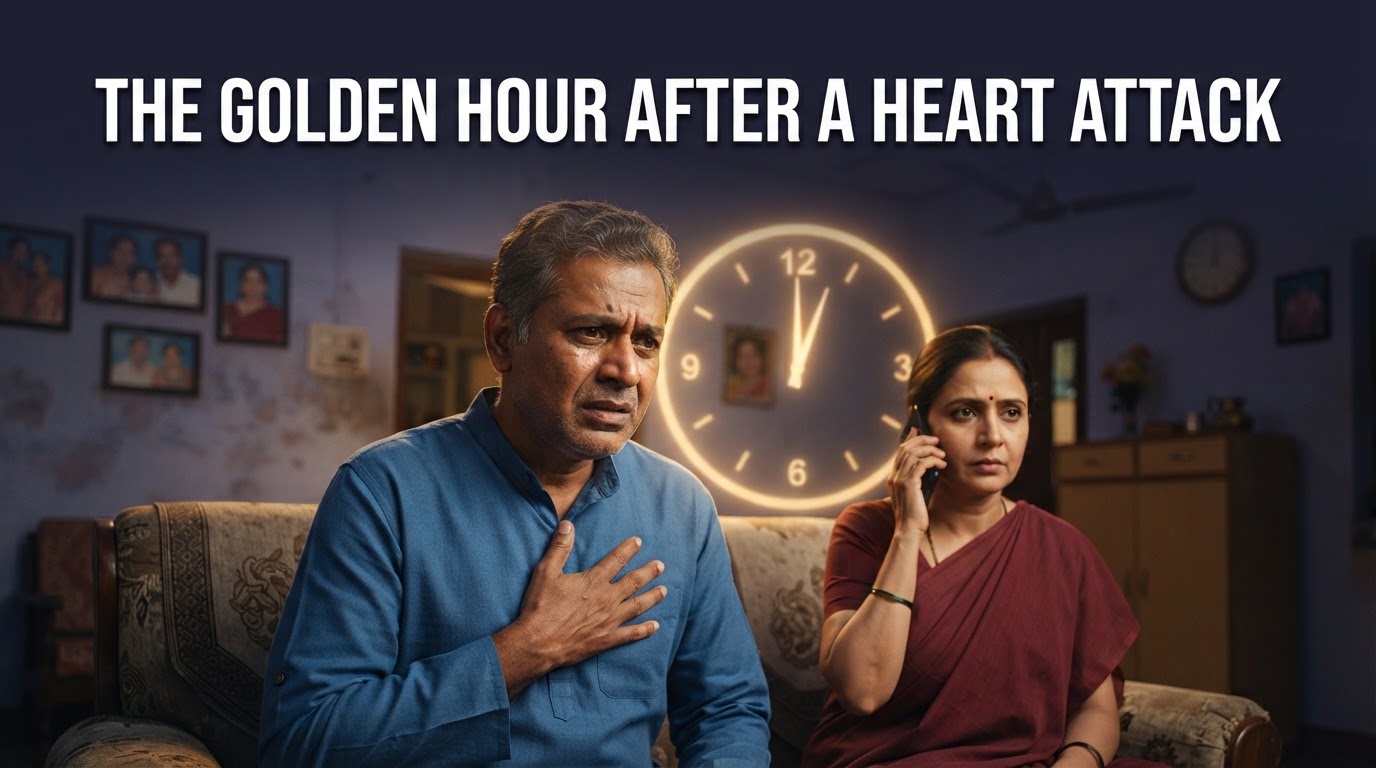
As an interventional cardiologist, the question I get asked most often not about the causes behind a heart attack, but about how much time do the patient actually have?
The answer is what we call “The Golden Hour”. While I can summarize it as it’s the first 1 hour after the patient experience several pain in the chest, but I would recommend everyone to spare some time reading this article, as I tried my best to give you as much information as possible.
Index: jump to any section
- What Actually Happens Inside the Heart During a Heart Attack
- What Is the Golden Hour, Exactly?
- Heart Attack vs. Cardiac Arrest: Know the Difference
- Recognizing the Symptoms
- What To Do In the Golden Hour: Step by Step
- What NOT To Do: Common Mistakes That Cost the Golden Hour
- The Golden Hour Doesn't End When You Reach the Hospital
- The Reality in India and in Odisha
- Life After the Golden Hour
- Frequently Asked Questions
What Actually Happens Inside the Heart During a Heart Attack
A heart attack happens when a blood clot suddenly blocks a coronary artery. The heart muscle downstream of that blockage stops receiving oxygen, and without oxygen, heart muscle cells begin to die. This is what doctors call myocardial infarction or literally, “death of heart muscle.”
The damage doesn’t happen all at once. It spreads outward. It starts in the innermost layer of the heart wall (the layer working hardest and needing the most oxygen) and moves outward toward the surface the longer the blockage remains. That’s the entire reason time is the variable I care about most in the emergency room. It’s not always the size of the clot, or the patient’s age. Its Time.
What Is the Golden Hour, Exactly?
The golden hour is the first 60 minutes after a heart attack’s symptoms begin. Let’s clear one confusion, Its not from when you arrive at the hospital, but from the moment the chest pain starts. If the blocked artery is reopened within this window, either with clot-dissolving medication or with angioplasty, the amount of heart muscle saved is at its maximum. Cardiologists worldwide treat this as the single most important window in acute cardiac care.
Here’s what the data behind that window actually looks like:
- Heart muscle cells begin dying within roughly 80–90 minutes of blood flow being completely cut off, and by around 6 hours, most of the affected muscle territory is damaged beyond recovery . Since heart muscles start to die within 80-90 minutes after it stops receiving blood, and within 6 hours, nearly all the affected areas of the heart could be completely damaged.
- According to the CDC, nearly 47% of deaths occur due to sudden cardiac arrests before an individual reaches the hospital, which is exactly why the response in the first minutes at home matters as much as what happens in the cath lab.
- Data cited from the NIH shows about half of those who die from heart attacks will die within an hour of their first symptom, and permanent damage can occur in as little as 30 minutes.
- Every 30–45 minutes of delay beyond the golden hour costs measurable heart function.
- In the first two hours, dangerous heart rhythm disturbances (heart blocks, ventricular tachycardia) are also most likely to occur, which is a separate life-threatening risk on top of the muscle damage itself In the first two hours marked changes in heart rate can occur leading to heart blocks with slowing of heart rate or ventricular tachycardia which can be fatal.
Heart Attack vs. Cardiac Arrest: Know the Difference
These two get used interchangeably, and that confusion costs lives, because the response is different.
- Heart attack: a circulation problem. A blocked artery starves part of the heart muscle of oxygen. The person is usually conscious, in pain, and breathing. Treatment is about reopening the artery fast either through medication or angioplasty.
- Cardiac arrest: an electrical problem. The heart stops beating effectively altogether. The person collapses, stops breathing normally, and has no pulse. Treatment is CPR and a defibrillator, immediately.
A heart attack can lead to a cardiac arrest if it’s not treated in time, which is one more reason the golden hour matters. But if you’re helping someone who is conscious and in pain, your first job is getting them to definitive treatment fast, not starting CPR.
Recognizing the Symptoms
The classic symptom is pressure, tightness, or squeezing discomfort in the centre of the chest, lasting more than a few minutes. But heart attacks don’t always announce themselves that clearly:
- Pain or discomfort radiating to the jaw, neck, back, or one or both arms
- Breathlessness, sometimes without any chest pain at all
- Cold sweats, nausea, or a feeling resembling severe indigestion
- Sudden dizziness or lightheadedness
- An unexplained sense of impending doom
Women, older adults, and people with diabetes are significantly more likely to present with these atypical symptoms Including breathlessness, fatigue, or nausea, rather than classic chest pain, which is a major reason heart attacks in these groups get diagnosed late.
What To Do In the Golden Hour: Step by Step
- Call emergency services immediately. Not a family member first, not a neighbour. Call for an ambulance and get moving toward the nearest hospital with cardiac facilities. Every minute spent deciding is a minute of heart muscle.
- Chew an aspirin, if not allergic. Aspirin thins the blood and can help limit clot growth while help is on the way. This should never delay the call for help. Make the call first.
- Keep the person seated or in a comfortable half-lying position, knees bent, and loosen tight clothing. Movement increases the heart’s oxygen demand at the worst possible time.
- If they become unresponsive and stop breathing normally, begin CPR: hands-only, hard and fast, at 100–120 compressions per minute, until help arrives.
- Do not wait to see if it passes. Heart attack pain that lasts more than a few minutes, especially with any of the associated symptoms above, is not something to sit out.
What NOT To Do: Common Mistakes That Cost the Golden Hour
- Don’t drive yourself to the hospital. If you lose consciousness at the wheel, you put yourself and others at far greater risk. Call an ambulance, or have someone else drive.
- Don’t dismiss symptoms as gas, acidity, or anxiety, especially in younger patients. Cardiac emergencies in people in their 30s and 40s are rising, driven by stress, poor sleep, and sedentary routines.
- Don’t spend the golden hour searching symptoms online instead of calling for help. By the time you’ve confirmed it’s serious, you may have used up a third of your window.
Don't assume a normal-looking person "doesn't look like" they're having a heart attack.
Presentation varies widely by age, sex, and existing conditions like diabetes.
The Golden Hour Doesn't End When You Reach the Hospital
This is the part almost no patient-facing article explains, and it matters just as much as the first 60 minutes at home.
Once a patient with a suspected heart attack reaches the hospital, the goal is to confirm it on an ECG within about 10 minutes, and if it’s a STEMI (ST-elevation heart attack, the most severe kind) to reopen the blocked artery with angioplasty within 90 minutes of arrival. This is called door-to-balloon time, and it’s the single biggest determinant of hospital-side outcomes.
Hospitals that consistently hit this target do it through pre-hospital ECGs done in the ambulance, one-call cath lab activation the moment STEMI is confirmed, and bypassing the emergency department entirely to move the patient straight to the cath lab. Where angioplasty isn’t immediately available, clot-busting medication (thrombolysis) is given first to buy time, a strategy known as pharmaco-invasive treatment.
The Reality in India and in Odisha
India carries one of the highest burdens of acute coronary syndrome in the world, and the numbers reflect it: the incidence of STEMI is higher (60.6%) and the mortality is more (8.6%) in the Indian population than in developed countries. The reasons aren’t purely medical, large sections of the population lack health insurance, medical emergency awareness is low, and transport and emergency medical infrastructure are often inadequate.
Distance is a real barrier here. With roughly 800 cath-labs and 3 million cases of STEMI in India nationally, and cath labs frequently located far from smaller towns and villages, reaching a cath lab within the Golden Hour is nearly impossible for many patients. National programs like STEMI India have proposed a hub-and-spoke model, primary care clinics and small hospitals feeding patients into larger centres with a coordinated pharmaco-invasive protocol, precisely to work around this gap.
This is exactly why preparedness matters more here than the average article assumes: knowing your nearest cardiac-capable hospital in advance, keeping emergency numbers saved, and acting the moment symptoms start, rather than waiting to see a family doctor first, can make the difference between reaching help inside or outside the window.
Life After the Golden Hour
Surviving the golden hour is the beginning, not the end, of recovery. What follows typically includes:
- A period of monitoring in a coronary care unit for rhythm disturbances
- Medications to protect the heart and prevent future clots (antiplatelets, statins, beta-blockers, as prescribed)
- Cardiac rehabilitation: a structured program of supervised exercise and lifestyle changes
- Long-term risk factor control: blood pressure, cholesterol, blood sugar, smoking cessation, and stress management
The extent of long-term recovery is closely tied to how much heart muscle was saved in that first hour — one more reason the golden hour deserves the attention it gets, and more.
Frequently Asked Questions
Q: Why is it called the "golden hour" and not the "golden 90 minutes"?
The term reflects the point of maximum benefit. Treatment within the first 60 minutes gives the best chance of minimal permanent damage, though benefit continues, at a declining rate, for several hours after.
Q: Can you survive a heart attack without knowing it happened?
Yes, this is called a silent heart attack, more common in people with diabetes, and it’s one reason regular cardiac checkups matter even without symptoms.
Q: Is it safe to give aspirin to someone having a heart attack?
Generally yes, unless they’re allergic to it or have been told otherwise by a doctor, but calling emergency services always comes first, never delay the call to find an aspirin.
Q: What's the difference between thrombolysis and angioplasty?
Thrombolysis uses medication to dissolve the clot; angioplasty mechanically reopens the artery with a balloon and stent. Angioplasty is generally more effective where available quickly; thrombolysis is used as a bridge when a cath lab isn’t immediately accessible.
Continue Reading
- Life After a Heart Attack: A Complete Guide to Precautions and Recovery
What recovery looks like once the emergency is over. - Silent Heart Attack in Diabetic Patients: Understanding the Symptoms You Might Miss
Why some heart attacks do not feel like heart attacks. - Heart Attack While Driving: Warning Signs Every Driver Should Know
What to do when symptoms strike on the road. - What Causes Heart Attacks in Young People?
Why heart attacks are appearing at younger ages. - Early-Stage Blood Clots Symptoms in the Heart: Signs, Causes, and Treatments
The early signals of a clot forming in the heart. - How Stress Affects Your Heart: Meaning, Mechanism, and Management Techniques for People with Heart Disease
How stress affects the heart and how to manage it.
